CASE STUDY · DATA PIPELINES & MARKET INTELLIGENCE
Global Job Intelligence
A cloud-powered job market intelligence platform that continuously transforms fragmented listings from global APIs and company career boards into structured, reliable, and decision-ready market signals.
Turning fragmented job listings into reliable market intelligence.
Job market data is distributed across independent platforms, company career pages, and applicant tracking systems. Each source uses different formats, classifications, salary structures, and publishing conventions, making consistent analysis difficult without a shared data model.
Global Job Intelligence brings these sources into one continuously operating system. It collects listings from six job-market sources and 60 company boards, standardizes the records, identifies duplicate opportunities, and stores the resulting data in PostgreSQL for analysis and reporting.
The result is a unified view of hiring activity that supports market exploration, salary analysis, opportunity discovery, and operational monitoring from a single interface.
A complete data pipeline built for consistency and scale.
Each source is handled through an independent collection and processing workflow because APIs and applicant tracking systems return different data structures. Raw records are validated, transformed, and passed through a shared normalization layer before being stored.
The platform standardizes employment types, seniority levels, company names, locations, timezone restrictions, and salary fields. A canonical parent-and-child category hierarchy maps inconsistent source labels into a shared taxonomy, creating reliable category filters and comparisons while preserving original source information for traceability.
Two complementary identity systems protect data quality. Source-level identifiers prevent the same record from being inserted repeatedly, while cross-source fingerprints identify opportunities that appear on multiple platforms. Duplicate source records remain available for provenance, but market metrics can represent them as one unique opportunity.
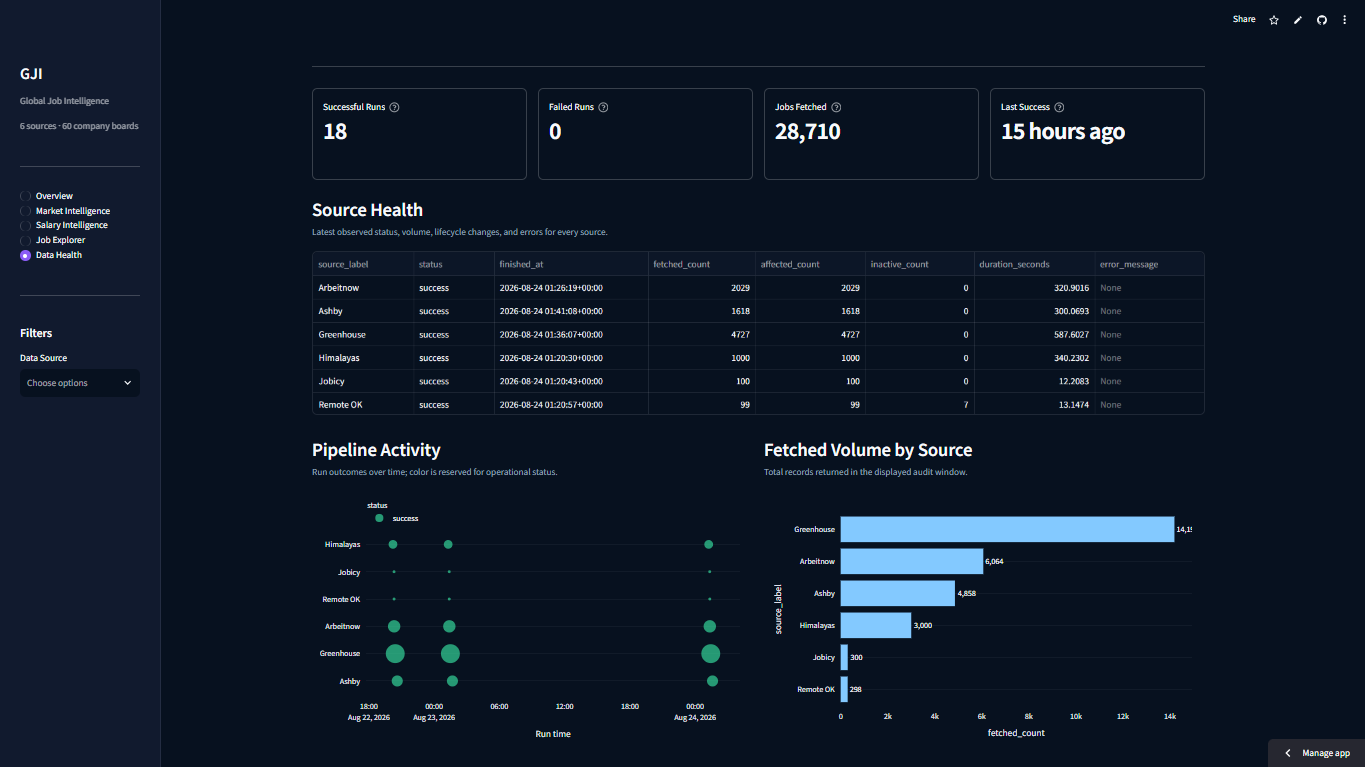
A failure in one source is recorded independently, allowing the remaining pipelines to continue operating. Every execution is logged with its status, record volume, duration, inactive listings, and error details.
- Multi-source API and company-board ingestion
- Source-specific validation and processing
- Shared data normalization and cross-source deduplication
- PostgreSQL database workflows
- Automated daily cloud execution
- Pipeline audit and source-health monitoring
- 93 automated tests covering collection, processing, persistence, analytics, and dashboard behavior
Market analysis designed around trustworthy comparisons.
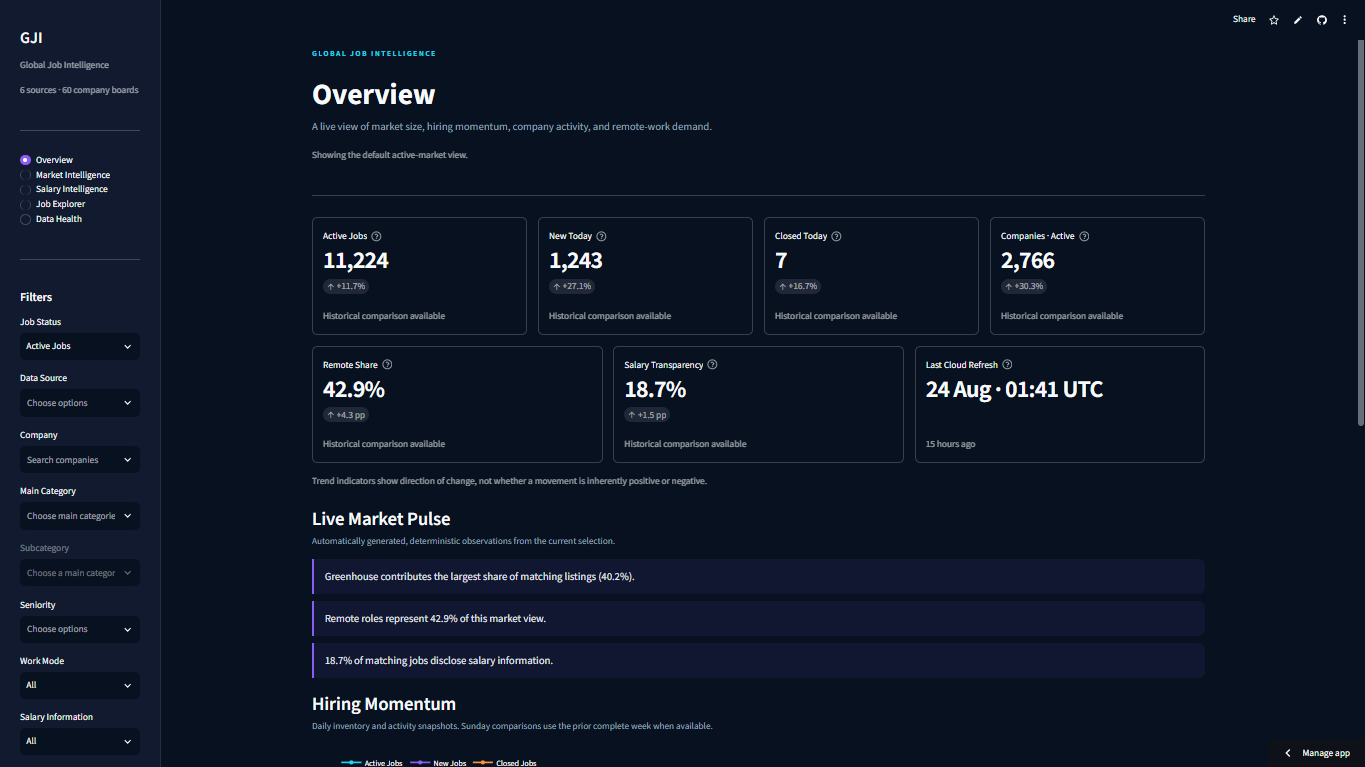
The dashboard converts the normalized database into a clear view of hiring demand, company activity, remote-work availability, seniority distribution, job categories, and salary transparency.
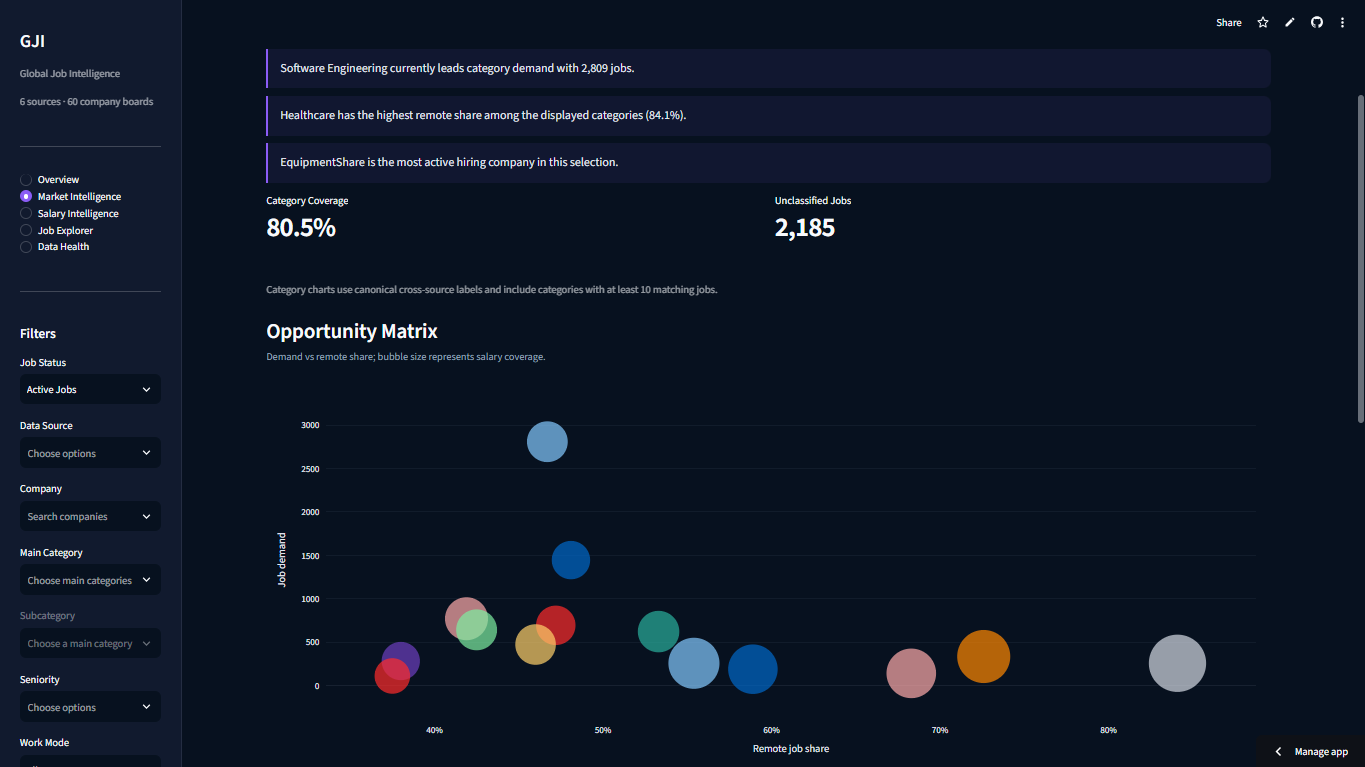
The Opportunity Matrix compares job demand, remote-job share, and salary coverage across categories, helping users identify areas where market activity and accessibility intersect.
Salary Intelligence protects analytical integrity by keeping incompatible currencies and salary periods separate. Annual, monthly, and hourly compensation values are not combined as if they represented the same unit, reducing the risk of misleading comparisons.
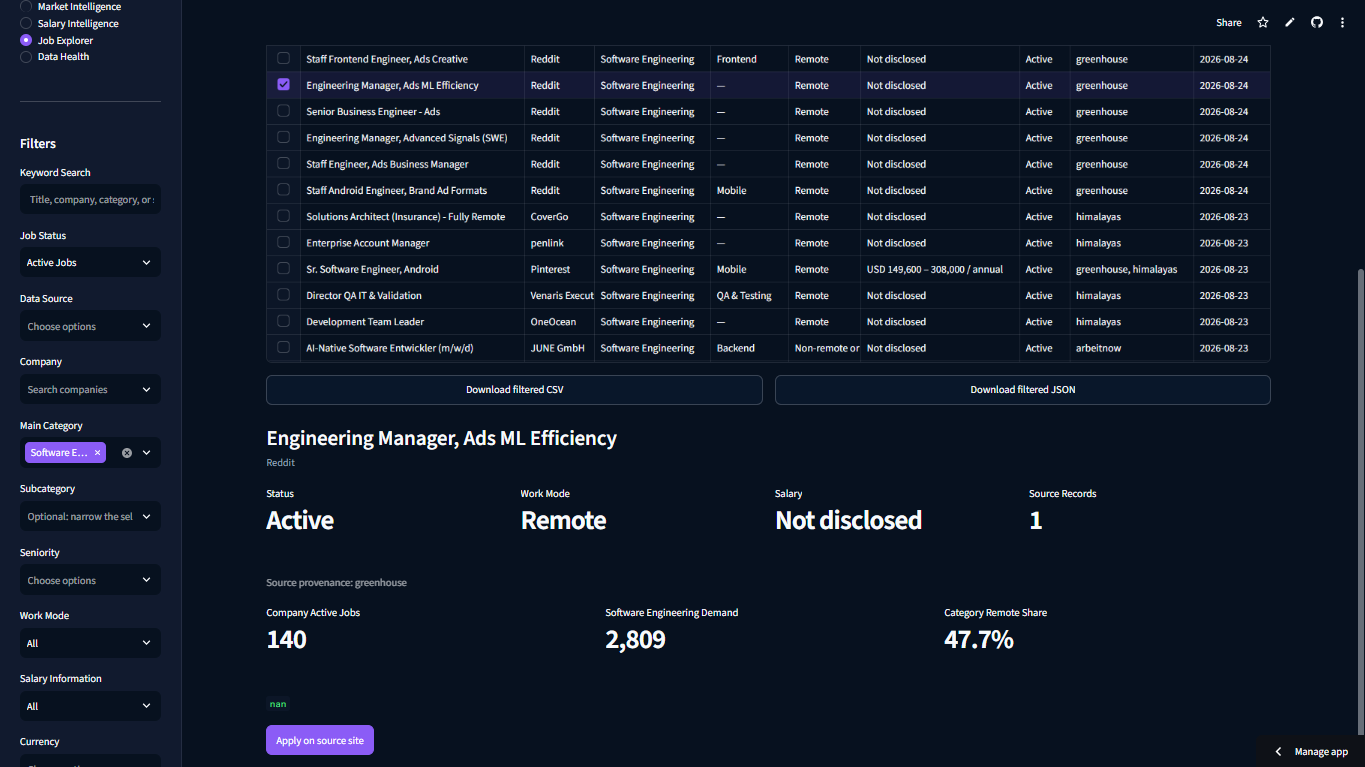
The Job Explorer provides a searchable and filterable view of deduplicated opportunities. Parent and child category filters work alongside location, remote status, seniority, employment type, salary, source, and keyword controls. Users can investigate individual listings, review source provenance, compare each opportunity with its wider market context, open the original application page, and export the filtered selection as CSV or JSON.
- Active, new, and closed opportunity tracking
- Hiring-company and category demand analysis
- Remote-work and seniority distribution
- Opportunity Matrix and Salary Intelligence
- Searchable Job Explorer with hierarchical category filters and structured exports
- Daily and weekly market trends
Operational visibility for a continuously running data product.
Job listings change over time, so the platform tracks more than the latest available records. Each opportunity includes first-seen, last-seen, and active-status information, making it possible to distinguish current inventory from closed opportunities and observe market movement over time.
Daily market snapshots preserve active jobs, new and closed opportunities, hiring companies, remote-work share, and salary transparency. These snapshots support historical comparisons as the dataset continues to grow.
The Data Health workspace provides visibility into source freshness, pipeline outcomes, fetched volumes, inactive records, execution duration, and failure messages. This makes data reliability part of the product rather than an invisible background process.
GitHub Actions runs the complete pipeline on a daily schedule. The processed data is stored in a Neon-hosted PostgreSQL database, and the Streamlit dashboard reads from the same cloud environment to present current market intelligence.
One product, from market overview to data health.
The interface brings market signals, hierarchical category exploration, opportunity-level filtering, salary context, and operational reliability into a consistent five-page dashboard. The platform is protected by 93 automated tests across the data and presentation layers.
Technology stack: Python · Pandas · PostgreSQL · Neon · Psycopg · Streamlit · Plotly · Requests · Pytest · GitHub Actions